
DANIEL AUSTIN
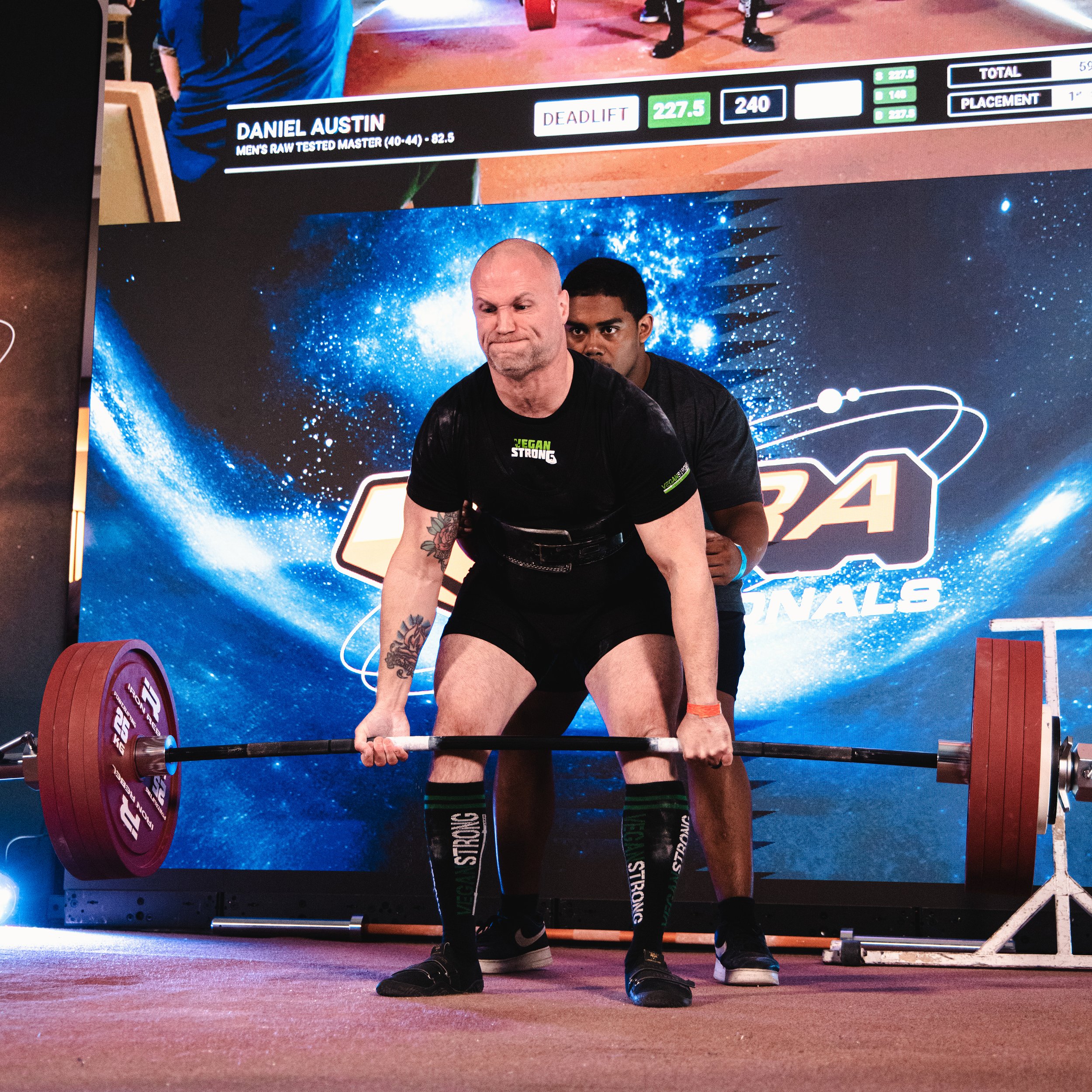
“A slogan I put on the back of my book is "Through vegan power, all things are possible." And I believe that more than ever. My own experience has taught me that. Vegans can absolutely achieve anything they want.”
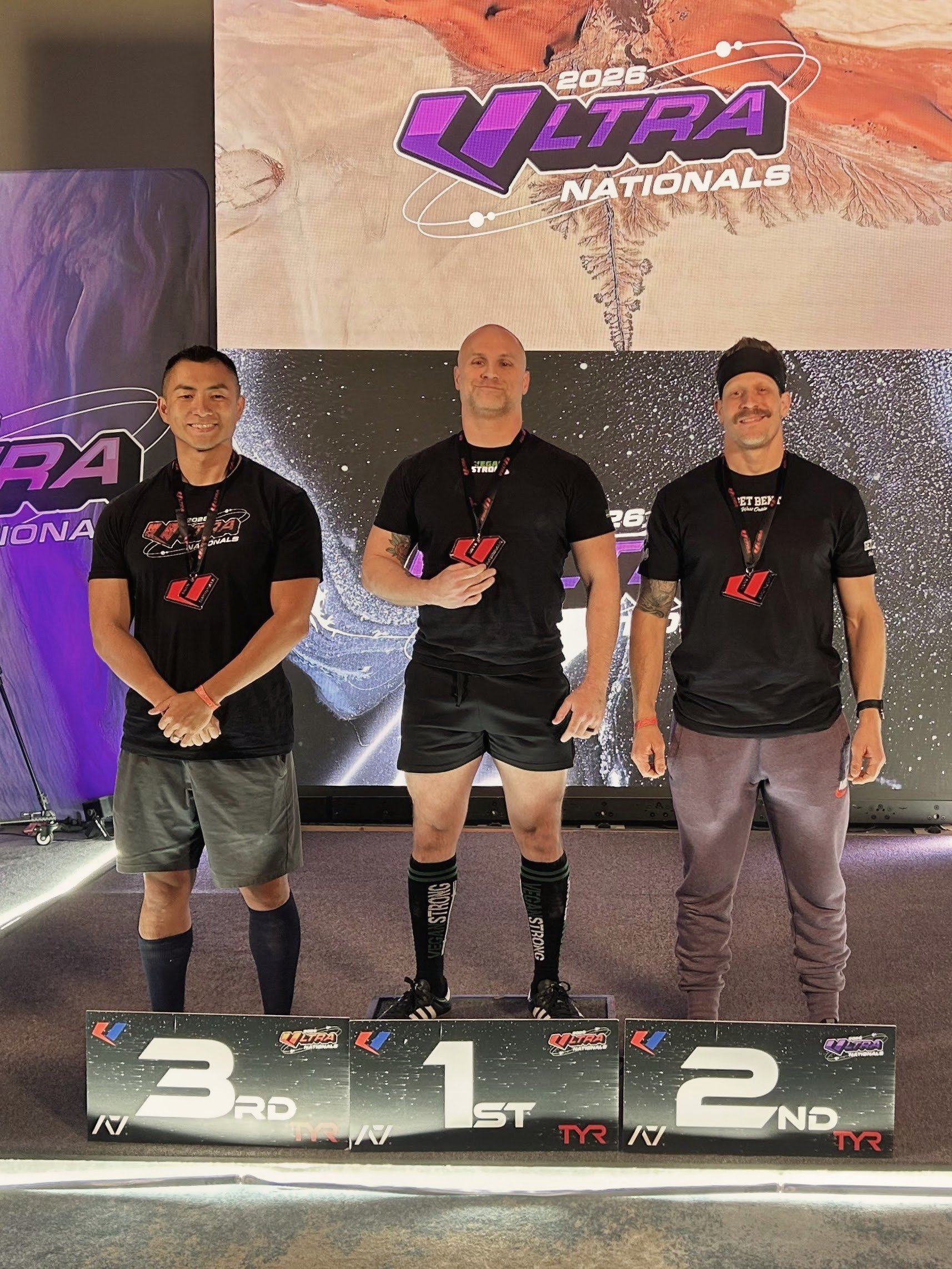
I went vegetarian at the age of 15, then vegan at 22. Now at 43, I've been vegan for 21 years, have won multiple national powerlifting meets and set many state records across 3 states I have lived in over the past 11 years. Veganism, powerlifting, and hardcore/creativity through music are my fountains of youth.
What was the moment or experience that first pushed you toward veganism?
Hard to pick one moment. I grew up with a vegetarian mother, so being a vegetarian was never anything weird to me, necessarily. I had even gone to anti-fur and anti-foie gras demonstrations with her in Houston as a kid, so activism wasn't foreign to me either. She never tried to make me be vegetarian though, but I always naturally enjoyed her black bean burgers over the rare-cooked bloody burgers my dad would grill, so I grew up eating a lot of vegetarian food. I truly didn't discover what veganism was until I was 14, heard Earth Crisis, and got involved in hardcore. I think all those background factors were my first nudges toward the lifestyle. Really, it was a long time coming. I still always say I wish I had gone vegan sooner.
Did your path into veganism come before or after you became involved in your sport?
Long before. I didn't first compete in powerlifting until I had been vegan for nearly ten years. I had been vegan for about four years before I even started lifting weights casually.
How did your friends, family, teammates, coaches, or wider community react when you made that shift?
My girlfriend at the time (2005) and I had a conversation about going vegan together, so that's what we did. My mom, who was a vegetarian since before I was born, thought we were being too extreme by going vegan when we announced our decision, but within a few months she went vegan too, so I had a lot of family support overall. Then my sister went vegan and my aunt went vegetarian. My dad's side of the family is a completely opposite type of story, and it really took them more than a decade to even be accepting of my decision or respect it seriously, but on my mom's side of the family, the herbivores had become the majority. In my band, Die Young, which was my main social group at the time, we had members who were vegetarian or vegan, or ex-vegans/vegetarians, so it was like it didn't matter among them. We were all friends regardless, and in the band, the non-veg guys have almost always been down to eat vegan on the road, at least most of the time, since forever.
Was veganism an immediate commitment, or something you gradually grew into?
I was vegetarian/pescatarian for 7 years prior to going vegan. I ate plenty of vegan food in that time and enjoyed it, but like a chump, I was hung up letting go of cheese pizza. Looking back, that seems ridiculous...
What ethical issue, such as animal suffering, exploitation, environmental concerns, health, or another, ultimately made veganism resonate with you?
Seeing the veal calf videos of mother cows and their babies being separated from each other, the way they cried for each other, and then the mother cow would run after the truck her calf was in... That was what ultimately got me to say it's time to give up the dairy, too. So it was an entirely ethical decision—to not pay other people to subject not just physical, but very emotional suffering on others—on entire families, really. There was no thought of health or environmental concern going through my head when I made the decision. I saw something indefensible being done to others, felt pretty ashamed that I had been supporting such a cruel industry all my life, even as a vegetarian for 7 years prior, and I knew from then on, I had to opt out of supporting it altogether.
How has being vegan affected your approach to training and competition?
I think it makes me train harder and take my mission more seriously. Vegans still have a lot to prove in the strength world. Once I started competing, I always told myself I was not allowed to ever come in last place of my category, and to this day I haven't, not even at Nationals or Worlds. Now that I compete at higher levels, it's even more important that I win my categories and represent for the animals as strongly and confidently as I can. Mainly, I realize my performance and sportsmanship always represent vegans at large, and it is a privilege to be an advocate, so that is a major factor in keeping me motivated to do my best.
Did you have any concerns about going vegan while pursuing your sport seriously?
I had been vegan a long time before I started dedicating myself to weight training, and being that veganism is an ethical choice for me, my mantra was always to just make it work. No matter what supplements would be required, if any, I would find a vegan variation of them and take them. Fortunately, a well-planned vegan diet can be one of the most nutrient-rich and diverse diets around, and if I wasn't training as hard as I do, I likely wouldn't need the majority of supplements I take. And even more fortunately, there is no essential vitamin, mineral, amino acid, etc., that isn't available in a vegan option these days, so that's just a miraculous reality we live in currently. I find most competitors who eat meat and dairy supplement as much or more than I do as a vegan anyway, though I would not have guessed that to be the case way back when... But if you think about it, who else has been keeping GNCs open all these decades? (Not vegans.) I have gotten my blood work done for years now and I have never been deficient in anything on the tests I have gotten. Not iron, not B12, not Vitamin D—none of the usual culprits for vegans, all which goes to show how effective simple supplementation can be. So as I have gone along, I have done my due diligence to learn as much as I can about nutrition to meet my goals, and I think that the original fear of being deficient as a vegan is what has made me be more on top of my nutrition. It's one of those cases where believing you might be starting at a disadvantage has actually given me an advantage because it made me sharpen my knowledge and strategies.
How did you navigate nutrition, recovery, and performance when you first became vegan?
That was a long process of trial and error. Like I said, me going vegan was strictly an ethical decision for the animals. I knew nothing about nutrition at the time. I did lose weight the first couple years and my dad thought I was worryingly skinnier. I was even flabbier due to muscle loss (the infamous "skinny fat" syndrome) but back then I was touring a lot, so I was generally living an unhealthy lifestyle to begin with, rarely sleeping well due to playing shows and frequent overnight drives, or eating fast food and gas station snacks. Also, just being broke and probably not eating enough. I had no concept of protein or micronutrition. Once I stopped touring so much and got settled into exercise routines, learned about nutrition, and so on, I remedied all of the above ailments in a year. But even then, as you try to progress in your training year after year, you have to keep learning more about managing your diet to hit specific goals. Your body and hormones will also change with age, and that will affect how you eat or train as well, so you have to adapt with the changing flow of the river.
Did being an athlete make people question your decision to go vegan?
The first time I placed at a powerlifting meet was at my third meet (I think), in 2016, and I got 2nd in my weight class. I recall a lot of people making jokes and whispering in the crowd when I went up to the podium for my medal, I think in part they did that because they thought my presence there was strange. I think those people were questioning how a vegan doing well at a competition was even possible. Even a couple judges cracked jokes while they congratulated me. And there would be jokes like that for a few more years here and there, but the more you win, the less people joke. I competed again in the Fall of that year and won 1st in my division, and the tone was changing toward me. When vegans win, veganism becomes normalized. Plenty of times at meets after I, or my teammates, have delivered a vulgar display of vegan power, other spectators or competitors will come up with a lot of compliments and genuinely curious line of questions. A lot of good conversations have come from that for years now. Sometimes people ask if we went vegan for any specific benefits, as if it in itself gives us advantages they don't know about. So over the past decade I have seen the vibe about veganism change in strength sports—as more of us vegans show up and win.
Have you ever had to deal with the idea that veganism and athletic performance are incompatible?
People have of course said that to me and fellow vegan athletes for decades, but I think for most of us it is just more fuel for our fire. Spite is also a great motivator. Think we can't do something? Watch us do it.
Have your experiences as an athlete challenged or reinforced anything you previously believed about vegan nutrition?
A slogan I put on the back of my book is "Through vegan power, all things are possible." And I believe that more than ever. My own experience has taught me that. Vegans can absolutely achieve anything they want. It's always a matter of dialing in the factors (like nutrition or training strategies) to be able to develop yourself according to your goals. When I see people giving up on veganism because they think they are performing worse on a vegan diet, or think they are losing too much weight, or whatever...I always know that they didn't care to troubleshoot with a vegan diet long enough to make it over the hump of their own learning curve. That's really the trick—if you go vegan, you have to learn how to make the lifestyle work for you based on your own goals. It is your responsibility to make all that come together. The knowledge and resources are out there. And when you do make all that happen, you will see that exactly what I said is true: Through vegan power, all things are possible.
Do you think being a vegan athlete gives you an opportunity to challenge some of the stereotypes surrounding veganism?
100%.
Have you ever had another athlete, coach, or training partner become interested in veganism because of your example?
Absolutely. I can think of many. And I even know athletes, whether formally competitive or impressive hobby lifters, who say I was an early inspiration to them to begin training, and some of them have far surpassed me in capability or accomplishments at this point. To that, I am honored to play my part in the evolution of vegan athleticism. I'm of course a very competitive person and I truly always want to be the best of the pack, but the reality is that we all have to do our best in our time and hope there will be a generation after us to carry the torch and lead by example to change minds—for the animals. Also, those phenomenal athletes I am talking about in turn motivate me to keep going and try to keep up with them.
Does being involved in competitive sports affect the way you think about concepts like strength, dominance, aggression, or violence toward animals?
I think lifting weights is a great form of therapy, meditation, and outlet for aggression. Competing taught me about discipline and how much it takes to be good at your craft and win. If you want to compete among the best, vegan or not, you actually have to become more cerebral, more methodical, more conscientious. Less impulsive, and more in control of your tendencies to aggression. Competition is not ultimately about aggression. Rather, it's about developing the skills to see goals through and be the best you can be. Those are real life skills. And then when you couple all that with a diet or lifestyle that is organized around the principle of doing as little harm as possible, I think it's the most powerful example I can think of for showing others that we can all accomplish so much without doing harm. Like the song says, "It takes strength to be gentle and kind."
Do you see any connection between the discipline required in athletics and the commitment required to live according to your ethics?
100%. We all need to find some dimension in our lives to learn a discipline. It doesn't have to be athletics, but it can be. The truth is, when we don't use our bodies, we lose them. Often when we lose our bodies we also lose our minds. I say lifting is meditational because it truly can bring you into the present moment, fully. Being present is what delivers us from anxiety. And also, if we develop muscle in our younger or middle-aged years, it will help make our senior years much easier, in terms of mobility and cognitive function. The discipline doesn't just help with living by our ethics, but it also rewards us for developing ourselves both physically and mentally.Do you think there is a contradiction between celebrating strength and athletic performance while accepting unnecessary suffering toward animals?
Not necessarily. There are non-vegans out there doing some amazing physical feats, and I don't think it makes someone's accomplishments any less amazing. Also, if we can't beat them, we can't say shit. There are many non-veg athletes I look up to as athletes. If they are better than me, I need to learn to keep up, and if I can learn to do that as a vegan, it will only help this cause. I only wish everyone knew they absolutely could achieve all the same things on a well-planned vegan diet—matching calories for calories, protein for protein, and so forth. But since many of the athletic world's all-stars aren't going to make that leap, not yet anyway, it is us vegans who need to pick up the slack and show what can be done.
How do you reconcile the competitive or aggressive aspects of your sport with a philosophy centered around compassion toward animals?
There will always be a place in the world for aggression and athleticism. What matters is how we channel it. For better or worse, the world has been shaped as we know it by aggressive people. One thing that is great about sports is that they can be ritually analogous to the bad kinds of aggression out there: violence, war, tribalism, etc. In sport, we are to play by rules, show respect to our competitors, even experience camaraderie with our opponents, and then enact a sort of play war. It's cathartic. And in that catharsis we can showcase the heights of human capability without bloodshed. It gives the world a drama it craves of winners and losers, but at the end of the day we shake hands, go home and try to improve for next time. Just about every culture in every age has put athletes on a pedestal, so yes, athletes do have a potential opportunity to get people to listen, as they have likely already earned the community's respect by doing things that are considered to be above mediocre. In regard to whether the athletic world could benefit for having a clearer culture of kindness to animals... Really, in terms of self-interest for the athletes themselves, whole food plant based diets are specifically more optimal for endurance athletes (not so much for strength athletes), so endurance-oriented athletes really should be eating more plants, no matter what. Also, the increased intake of fiber and antioxidants from whole food plant based diets are associated with longevity, so right there you have two big reasons why more athletes should be eating plants and not animals. That doesn't really have to do with ethics, but the animals themselves will be happy people aren't killing them, no matter what the reason
What misconceptions about vegan athletes do you encounter most often?
People think we are all on steroids. It's a cope for intellectually stunted people who can't accept that a vegan diet can be as good as any for performance, and that sometimes it is just better. I know maybe 3 vegans on steroids, and they are very open about it. The rest of us, I assure you, are not, and that why we compete in drug tested federations. If we're good at our shit, you just better believe it. Vegan Power is real.
What would you say to an athlete who is interested in veganism but worries it will negatively affect their performance?
A commitment to veganism, and likewise to being a vegan lifter or athlete, all comes down to your dedication to abide by what you know in your heart is either right or wrong. Are you going to make it work for yourself, or not? Is it wrong to pay people to breed and kill animals, or not? If your heart is telling you that killing animals is wrong, well then, good news: You can absolutely be your best and strongest self as a vegan. All the resources and community you need to do it right are out here. It's on you to gather that information and put it to use. So, are you going to do what you know is right, or not?
What would you say to someone who cares about animals but hasn't yet been able to make the commitment to veganism?
Hey, better late than never. Don't say never, either. You can give up cheese. I did it, and damn, how I wish I did it way sooner.
What do you think the vegan athletic community is still missing?
I don't see as many strong young vegans coming up. It seems to me that a lot of the younger generation is less physically apt, which is unfortunate, but what the vegan athletic movement needs is the young bucks coming up to raise the bar of performance set by my generation. Most vegan athletes I know are at least in their 30s. Almost no one on my team is of "Open" age (which, depending on the sport, is 30 or 35, or younger). Most of my teammates are Masters and Submasters age (35-40+), so what we need are some youngsters to develop their strength and become some real vegan monsters.
Final Thoughts:
One thing the vegan community needs to do better:
Take your B12 and stop being neurotic argumentative people. Being healthy and leading by example is how we gain affluence in the long run. No one is coming to our side—which is the animals' side and the planet's side—if we are not enjoyable people to be around. So get your head right, take care of your body, work on your mind-body connection, and do the fucking work to change some minds.
If you could put one message in front of every athlete in the world, what would it say?
Going vegan is the best decision I ever made, and hopefully the way I live demonstrates that. At 43, and as a vegan for 21 years, I am the strongest I’ve ever been, and I’m stronger than most dudes in my bracket, so there is nothing to lose when you do what’s right for the animals. My only regret is not going vegan sooner.
Make SURE TO CHECK OUT ALL OF DANIEL’S BANDS ALONG WITH HIS BOOK!
Linktree can be found below.